
Walk down the juice aisle and everything looks like a health decision.
Bright colors. Fruit everywhere. Words like "natural," "pure," "immunity boost," "wholesome goodness." Green bottles that feel like they belong in a farmer's market. Labels that practically whisper you're doing something good for yourself.
What they don't lead with? The 26 grams of sugar sitting right behind all that optimism.
The juice industry has spent a century building one of the most effective health halos in food marketing history — and most people have never once questioned it. But the math doesn't lie. An 8-ounce glass of orange juice and a can of Coke carry nearly identical sugar loads. Apple juice? Six teaspoons of sugar per glass. Cranberry juice — the one people reach for when they're "being healthy" — clocks in at close to 7 teaspoons. No added sugar. Just nature doing what the label says it does.
The juice aisle isn't a health aisle. It's the soda aisle with better PR.
How Juice Built Its Halo (And Never Gave It Back)
The story starts in the 1920s, when commercial juice production took off. By the 1940s, Minute Maid was selling frozen orange juice concentrate across the country, and between 1920 and 1950, juice sales increased 300 percent. Juice became synonymous with breakfast, with health, with doing the right thing for your body.
Decades later, the industry doubled down. When consumers started questioning sugar in the 1990s and 2000s, juice companies didn't reformulate — they fortified. Calcium. Vitamin D. Omega-3. Probiotics. They added nutrients that made the product sound more medicinal, more intentional, more justified. The health halo didn't just survive — it got brighter.
Meanwhile, the actual sugar content never moved.
A standard glass of orange juice delivers about 23 grams of sugar. The American Heart Association recommends no more than 25 grams of added sugar per day for women, and 36 for men. That means a single morning glass of OJ puts most women at their daily limit before they've taken a single bite of food. And as registered dietitian Beth Czerwony noted bluntly: how many of us only drink an 8-ounce glass?
The "Natural Sugar" Sleight of Hand
Here's where the marketing gets really clever.
Juice brands don't have to disclose "added sugar" the way soda companies do — because the sugar in juice is technically natural. It came from fruit. That sounds clean, until you realize that your body doesn't care where the sugar came from. 8 ounces of orange soda and 8 ounces of orange juice can deliver the same 23 grams of sugar, hitting your bloodstream at nearly the same speed.
The difference? The soda label says "added sugar." The juice label says "natural sugar." Same blood sugar spike. Very different consumer perception.
And it gets worse. When you juice fruit, you strip out the fiber. Fiber is what slows sugar absorption in whole fruit. It's what makes an orange satisfying in a way a glass of OJ simply isn't. Eating a medium orange gives you 10–13 grams of natural sugar, plus fiber, plus water, plus the physical act of chewing that registers in your brain as a meal. Drinking an 8-ounce glass of orange juice means consuming the equivalent of four oranges — without any of those protective buffers. The sugar hits fast. The fullness never arrives.
Registered dietitians have started saying the quiet part out loud: view juice as your dessert. Not your health drink. Not your morning routine. Your dessert.
When "Fruit Drink" Is Just Soda with a Different Label
100% juice at least has the real thing inside. Slide further down the aisle into "juice drinks," "fruit cocktails," "fruit punches," and "juice beverages" — and the story gets darker.
These products can contain as little as 1–2% actual juice. The rest? Water, high-fructose corn syrup, artificial color, artificial flavor, and whatever micronutrients are needed to qualify for an "immunity" claim on the front of the bottle. Research has found that child-directed fruit drinks are more likely to make micronutrient claims on the front of the package — vitamin C badges, sunshine imagery, "natural" language — while the ingredient list tells a completely different story in very small print.
Parents buying "fruit punch" for their kids because it says "made with real fruit" on the label aren't making a health choice. They're being marketed to. The FDA's updated 2024 "healthy" labeling rules tried to address some of this — tightening what can legally be called healthy on packaging — but the gap between what's technically legal and what's genuinely nutritious remains wide enough to drive a refrigerated truck through.
Lawsuits have followed the deception. Brands have faced legal action for depicting fruits and vegetables prominently on labels when those ingredients made up a fraction of a percent of the actual product. The marketing looked like a health food. The contents looked like a candy drink.
The Industry Knows. It Just Hasn't Fixed It Yet.
This isn't new information inside the industry. Juice executives, analysts, and market researchers have been talking about the sugar problem for years.
Industry reports show that nearly half of consumers globally are actively trying to limit sugar. Health-conscious consumers have grown skeptical — not just of fruit drinks, but of 100% juice too. Sales have declined. The category is under pressure.
The industry's response has largely been to tinker at the edges: introduce "light" versions, launch zero-sugar juice drinks sweetened with stevia, add functional ingredients to justify the sugar load, or quietly pivot into adjacent categories. What hasn't happened, on any meaningful scale, is a genuine rethink of what juice should be.
As one industry analyst put it: marketers are still trying to crack the code.
The code, it turns out, isn't that complicated. Give people real fruit flavor. Cut the sugar dramatically. Be honest about what's in the bottle. Don't fake health — actually deliver it.
What Juice Is Supposed to Look Like
This is where Loom comes in.
Loom isn't a juice brand pretending to be something it's not. It's a brand that started from the problem: juice should taste like juice, not like you're paying a health tax on a sugar delivery system.
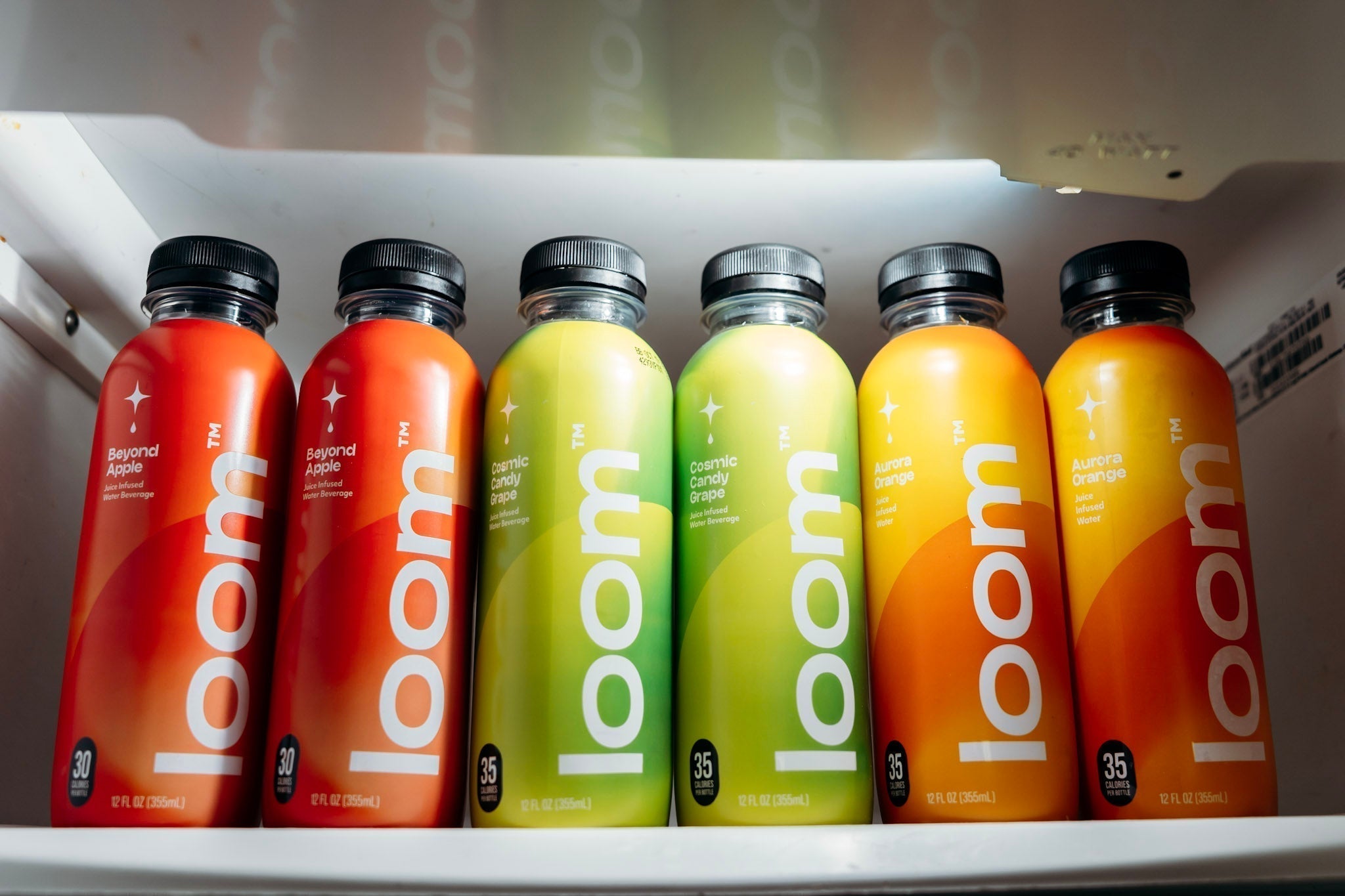
Loom's juice water delivers real fruit flavor — genuine juice, real ingredients, no engineered extras — at 1/4 the calories & sugar of traditional juice. No added sugar. Non-GMO. Gluten-free. Vegan. Kosher. And aseptically bottled to lock in peak flavor and color without the plastic contamination risk that comes with hot-fill bottling.
The flavors don't pretend to be clinical. Midnight Mango. Aurora Orange. Moon Punch. Beyond Apple. Cosmic Candy Grape. Dark Cherry. These are drinks that actually want to be enjoyed — they just don't require you to trade your health to enjoy them.
And Loom puts its money where its values are: every bottle sold funds the removal of one plastic bottle's worth of waste from the environment. Certified plastic neutral. Because a drink that's good for you shouldn't come at the planet's expense either.
The Bottom Line
The juice aisle built its reputation on the idea that fruit equals health. And whole fruit really does. But somewhere between the orchard and the bottle, the industry decided that sugar was fine as long as the label used the right words.
Natural. Pure. Wholesome. No added sugar.
What they meant was: we kept the sugar, removed the fiber, stripped the satiety, concentrated the calories, and dressed it up in green packaging.
You deserve better than that. Your body knows the difference between marketing and nutrition, even when the label doesn't make it easy to tell them apart.
Juice doesn't have to be a compromise. It doesn't have to be a sugar bomb with a health halo. It doesn't have to pretend.
Loom is what happens when juice stops pretending.
