
You're standing in the juice aisle. You pick up a bottle. The front of the label says "No Added Sugar" in clean, confident type. Maybe there's a piece of fruit nearby. Maybe the color palette is green and white, the universal language of health food.
Your brain registers: good choice.
Here's the thing. That label isn't lying. But it isn't telling you the whole truth, either. And the gap between those two things is where most people get misled.
What "No Added Sugar" Actually Means (Legally)
According to the FDA, "no added sugar" means exactly what it says: no sugars or sugar-containing ingredients were added during processing. No high-fructose corn syrup. No cane sugar. No honey. No concentrated fruit juice used as a sweetener.
That's it. That's the whole claim.
It says nothing about how much total sugar is in the product. It says nothing about how that sugar behaves in your body. It says nothing about whether you should be drinking 12 ounces of it before breakfast.
A bottle of 100% apple juice with 28 grams of sugar can wear the "no added sugar" badge with complete legal accuracy. So can a cranberry juice with 7 teaspoons of naturally occurring fructose. The claim is technically true. The nutritional story is a lot more complicated.
Natural Sugar vs. Added Sugar: Why the Distinction Matters Less Than You Think
There's a real and important difference between natural and added sugars in whole foods. In an apple, the natural sugar comes packaged with fiber, water, and phytonutrients. The fiber slows digestion and sugar absorption, meaning the glucose enters your bloodstream gradually. You also feel full. You probably don't eat five apples in one sitting.
But here's what changes when you juice that apple: the fiber is gone. The skin is gone. The pulp is mostly gone. What you have left is concentrated liquid fructose that your body absorbs almost immediately — producing a blood sugar spike that looks a lot more like a soda than a piece of fruit. The sugar is still technically "natural." Your bloodstream doesn't know the difference.
As one food scientist put it plainly: on a biological level, your body processes all sugars the same way. The distinctions that matter for health — the fiber, the matrix, the satiety signals — disappear the moment fruit becomes juice.
The Label That Leaves Out the Most Important Number
Here's what makes the "no added sugar" claim particularly effective as marketing: it's a negative claim. It tells you what's NOT in the product, which feels reassuring. But negative claims don't tell you what IS there.
A product can simultaneously carry:
-
"No added sugar" — true, nothing was added
-
28 grams of total sugar — right there on the nutrition facts, in smaller type
-
"Natural" on the front label — also technically true
-
A blood sugar response similar to a sugar-sweetened beverage — nowhere on the label at all
The American Heart Association recommends no more than 25 grams of sugar per day for women, 36 for men. A single standard glass of apple juice — no added sugar, all natural — delivers 24 grams before you've finished your morning. Most people don't pour exactly 8 ounces.
This isn't a loophole that the industry accidentally stumbled into. The "no added sugar" claim exists precisely because consumers have been conditioned to fear added sugar. Labeling something without added sugar in a world where people are scanning for that language is a deliberate marketing choice.
The Claims That Mean Even Less
"No added sugar" is at least a regulated term with a specific FDA definition. Some of the language surrounding it on juice labels is considerably looser.
"Lightly sweetened" is not regulated. It means nothing specific.
"Made with real fruit" can be accurate when fruit makes up 2% of a product's total content.
"Natural flavors" is a term covering hundreds of possible ingredients processed from natural sources — a far cry from the freshly squeezed implication the packaging tends to suggest.
"Wholesome" and "goodness" are not regulated at all. They are vibes, not claims.
The FDA updated its "healthy" labeling rules in late 2024 to tighten what products can call themselves healthy — requiring that foods meet standards for both beneficial food groups and limits on added sugar, sodium, and saturated fat. But the gap between what's technically legal to print on a label and what a consumer reasonably understands when they read it remains enormous.
What to Actually Look At
When you pick up a juice — any juice — here's the checklist that matters:
Total sugars, not just added sugars. This is the number that tells you what your body is actually going to deal with.
Serving size. Many juice nutrition labels are calculated on 8 ounces. The bottle in your hand might be 15.2 ounces. Do the math before the label flatters you.
Ingredients list. Juice concentrate near the top of the list means a lot of sugar is coming, regardless of what the front of the bottle says.
What's not in it. Fiber, protein, fat — these are the nutrients that slow sugar absorption and make a drink satisfying. Most conventional juice has essentially none of them.
What Real Transparency Looks Like
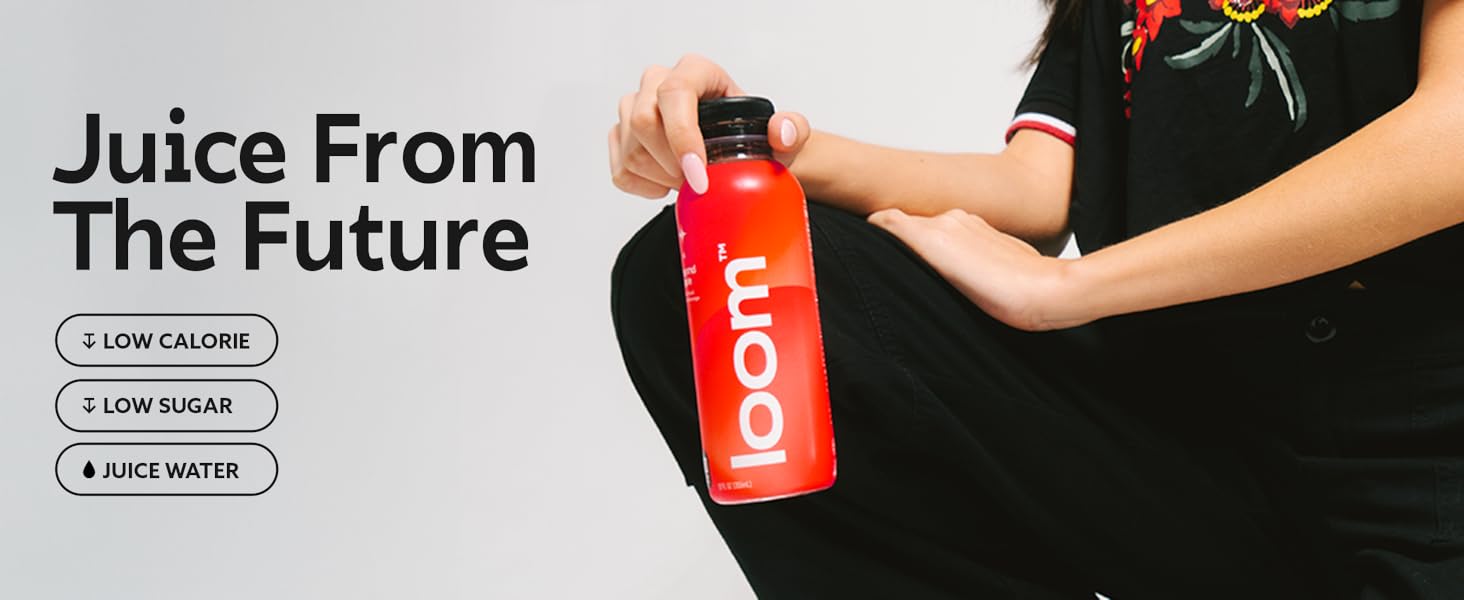
Loom doesn't hide behind label language. The whole point is to give you real fruit flavor — genuine juice, real ingredients — with half the sugar and half the calories of traditional juice. Not because we removed the sugar and called it something else, but because we built the product around not needing to.
No engineered extras. No added sugar. No inflated claims. Just a juice that does what juice should do — taste like something, refresh you, and not leave you reading the label like a contract.
That shouldn't be a revolutionary product. But in this industry, it kind of is.
Sources
-
FDA — Added Sugars on the Nutrition Facts Label https://www.fda.gov/food/nutrition-facts-label/added-sugars-nutrition-facts-label
-
FDA — "No Added Sugar" Claim Definition (Sugar 101) https://www.heart.org/en/healthy-living/healthy-eating/eat-smart/sugar/sugar-101
-
American Heart Association — How Much Sugar Is Too Much? https://www.heart.org/en/healthy-living/healthy-eating/eat-smart/sugar/how-much-sugar-is-too-much
-
American Heart Association — What's the Difference Between Sugar Free and No Added Sugar? https://www.heart.org/en/healthy-living/healthy-eating/eat-smart/sugar/difference-between-sugar-free-and-no-added-sugar
-
FDA — Finalizes Updated "Healthy" Nutrient Content Claim (December 2024) https://www.fda.gov/food/hfp-constituent-updates/fda-finalizes-updated-healthy-nutrient-content-claim
-
Hogan Lovells — FDA Issues Final "Healthy" Rule Summary https://www.hoganlovells.com/en/publications/fda-issues-final-%E2%80%9Chealthy%E2%80%9D-rule
-
Kendall Reagan Nutrition Center — Decoding Sugar on the Nutrition Facts Label https://www.chhs.colostate.edu/krnc/monthly-blog/decoding-sugar-on-the-nutrition-fact-label/
-
Augusta Health — Understanding Natural vs. Added Sugars https://www.augustahealth.com/2022/11/understanding-the-sweet-stuff-natural-vs-added-sugars/
